


Meet Dr. Vanessa de Andrade: Postdoctoral researcher and IES Fellow
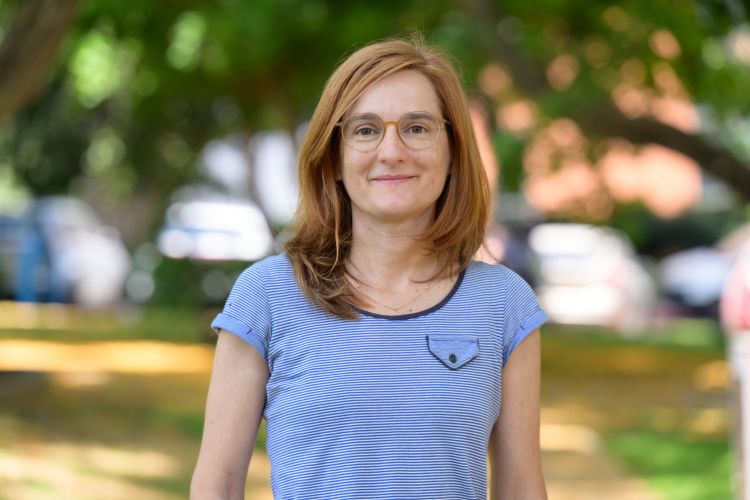
Photographed by the Weizmann photography unit
Meet Dr. Vanessa de Andrade, a postdoctoral researcher at the Weizmann Institute of Science, in the lab of Dr. Michal Haskel-Ittah, Department of Science Teaching, and an Institute of Environmental Sustainability (IES) fellow.
What is your professional background which led you to the Weizmann Institute of Science?
My path to the Weizmann Institute began during my doctoral research at the University of Lisbon, where I was awarded a fellowship from the FCT (Portuguese Foundation for Science and Technology). My PhD focused on a question that has driven my work ever since: how might drawing help middle school students to “better” understand and explain phenomena in science? Addressing this question, I became increasingly interested in how students reason about phenomena that occur through mechanisms they cannot directly perceive, such as atoms and molecular interactions, and how drawing uniquely serves as a thinking tool in that process, not as an artistic activity, but as a way of coming to understand and learn in science.
As part of my PhD, I had the opportunity for a research stay abroad, and I chose to work with Dr. Yael Shwartz at the Department of Science Teaching. Her work on how students develop increasingly sophisticated modeling practices—what they choose to include or omit in their visual representations, and how that capacity grows over time—spoke directly to my own interest in drawing as a tool for scientific thinking. The collaboration with Dr. Yael Shwartz continued after I returned to Portugal, and we have since published together. That visit also opened other doors: I participated in a seminar organized by Dr. Michal Haskel-Ittah, who is now my PI at Weizmann. What began as a short-term visit became the foundation of a long-term relationship with the Institute.
What makes Weizmann unique from other institutions?
What makes Weizmann distinctive is difficult to reduce to a single thing — it is more of a constellation. What I most like about Weizmann is the intellectual culture: an environment where ideas are genuinely challenged, and new approaches are met with curiosity. This is a place that values new ideas and perspectives, and that openness is what science is about.
And then there is the campus itself, an extraordinary place, with its natural environment, its gardens, reflecting something about the Institute’s character: a serious, long-term commitment to the world it inhabits. There really is no place quite like it.
How does your work relate to the IES and what does the IES mean for you?
My current research at Weizmann aims to understand how young people reason about climate change — a question that, in itself, is a sustainability challenge. The IES — Institute for Environmental Sustainability — awards postdoctoral fellowships each year to researchers working on sustainability-related questions, and science education research is part of this conversation: understanding how the next generation thinks about the planet is as consequential.
Climate change and environmental phenomena are genuinely difficult to grasp. My research investigates why students struggle to reason about causes and effects separated by vast distances and time spans—why deforestation in one continent affects weather patterns in another, or why today’s actions shape ecosystems decades from now. Being able to think across those gaps is an essential skill for understanding climate change and environmental phenomena. That is what my IES project is about.
Being awarded this fellowship meant belonging to a community of scientists working on one of the most urgent challenges of our time—a community where knowledge and perspectives flow across disciplines, and where the question of how people come to understand climate change is as central as the science of climate change itself.
Where have you been published so far?
My work has been published in leading journals in Science Education research, including Science Education and Research in Science Education. One published study (https://doi.org/10.1002/sce.21685) examines how drawing, gesture, and talk work together to enable students to reason about invisible mechanisms—showing that drawing is not merely a record of thinking, but an active cognitive tool that generates and sustains reasoning in action. A second paper theorizes drawing as a shared social-cognitive space, where individual thinking becomes collective understanding (https://doi.org/10.3390/educsci12010045). An analytical framework I developed for assessing students’ scientific explanations has been widely adopted, informing subsequent research across science domains (https://link.springer.com/article/10.1007/s11165-017-9648-9). I also contributed a chapter to a recently published Springer volume on mechanistic reasoning in science education (https://link.springer.com/book/10.1007/978-3-032-10246-1).
Work from my current IES project has been accepted at international conferences, such as the ISLS—International Society of the Learning Sciences, and a paper is currently under review for an issue in Multimodal Literacies and representations for Learning at Research in Science Education.
What types of collaborations have had in your research?
Collaboration has been central to the development of my research. Most recently, I have been building a collaboration with the Science Humanities research group at the Norwegian University of Science and Technology (NTNU) in Trondheim. This group, led by Professor Annette Lykknes, brings together researchers who study how drawing and other representational practices support thinking and learning in science. What began as a meeting at a conference in Porto has grown into an ongoing exchange: I served as Mid-Way Reader for a doctoral candidate at NTNU, joined their working group on drawing, thinking, and learning, and was invited as a speaker at their spring seminar in May 2026:a gathering of international researchers, teachers, and students around the question of whether and how drawing can help learners grasp dynamic and complex phenomena.
Within Weizmann, I am also beginning to establish new connections across the Department of Science Teaching, where the proximity of researchers working on different scientific domains (biology, chemistry, mathematics) opens up productive conversations about the shared challenges of science education.