


Long before scientists began studying them in the lab, mind-altering substances were already being gathered from plants, fungi and even animals for use in rituals, healing practices and mental health treatment. Researchers at the Weizmann Institute of Science have now managed to bring together in a single organism five psychedelic substances that in nature are scattered across the tree of life. After uncovering how plants naturally produce one of the best-known psychedelic compounds, DMT, they were able to reengineer that process step by step inside a model plant – along with four other psychedelics. The result is what amounts to a biological factory that could, in the future, be used to simultaneously produce multiple psychedelic molecules, including some that do not naturally occur in plants.
The study was led by Dr. Paula (Shirley) Berman, who worked at the time in Prof. Asaph Aharoni’s lab in Weizmann’s Plant and Environmental Sciences Department; she is now a principal investigator at the Agricultural Research Organization – Volcani Institute. The findings were recently published in Science Advances.

The five compounds in the study – all well-known psychedelics – come from three different kingdoms of life. The plant kingdom contributed DMT, the brain-active component of ayahuasca, a ceremonial hallucinogenic brew long used in shamanic Amazonian rituals for spiritual healing. The researchers derived DMT from several plant sources, including the leaves of a woody shrub from the coffee family, native to the Amazon rainforest, and the bark of an acacia species native to the Australian outback.
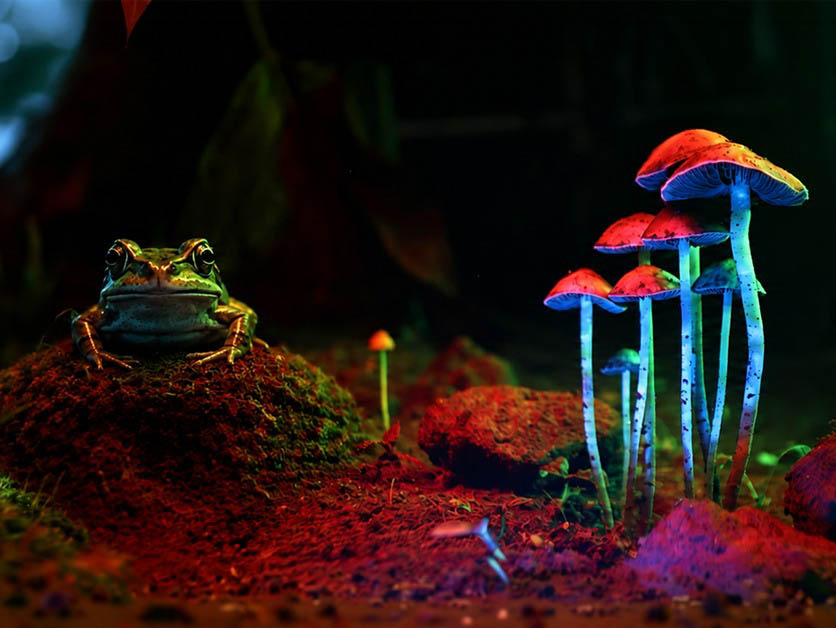
From the kingdom of fungi they took psilocybin and psilocin – the compounds responsible for the effects of “magic mushrooms,” with psilocybin once having been central to Aztec ceremonies. Representing the animal kingdom was the Sonoran Desert toad; it has glands on its head and skin that release a milky defensive secretion when it is stressed. This secretion contains bufotenin, as well as a more potent relative of DMT called 5-MeO-DMT, known to induce distinct psychedelic experiences – a fact well-known by those who have sought out the toad with the express purpose of licking it.
“”In effect, we created a kind of biological cocktail – not by mixing substances externally, but by combining the underlying pathways inside one organism”
Despite their diverse origins, all five compounds belong to the same chemical family and share the same starting point: tryptophan, a common amino acid found in all living organisms. This is also the starting point the human body uses to produce serotonin, a neurotransmitter involved in regulating mood and well-being. That shared origin helps explain why psychedelics act on the same receptors in the brain as serotonin.
“At the heart of the study was the challenge of making DMT,” explains Aharoni.

Although scientists had previously mapped the general route of DMT production in nature, the exact genes and enzymes responsible were still unknown, and identifying the complete biosynthetic DMT pathway remained elusive. The researchers began by identifying the key genes, particularly those encoding the enzymes that drive each step of the pathway. They then inserted these genes into a model plant – Nicotiana benthamiana, a tobacco relative widely used in research – effectively teaching it to produce DMT. Within days, the engineered plant began generating the compound.
When the scientists produced the other four psychedelics individually in separate tobacco plants, one of them – 5-MeO-DMT – was manufactured in surprisingly low amounts. To address this, the team collaborated with Prof. Sarel Fleishman and Dr. Olga Khersonsky of Weizmann’s Biomolecular Sciences Department, experts in protein design. They identified a subtle problem: a molecule that did not fit well into the active site of one of the enzymes. By changing a single building block – one amino acid – in the enzyme’s structure, they improved the fit.
The result was dramatic. “We mutated one amino acid in the sequence and got a 40-fold increase in the production of 5-MeO-DMT,” Berman says.
The scientists then introduced genes for the five compounds into the same plant. The system worked. A single plant was able to produce all five psychedelics: plant-origin DMT; fungus-origin psilocin and psilocybin; and animal-origin bufotenin and 5-MeO-DMT.
“In effect, we created a kind of biological ‘cocktail’ – not by mixing substances externally, but by combining the underlying pathways inside one organism,” Aharoni says.

At the same time, the experiment revealed an important limitation. When multiple pathways were activated at once, they began to compete for the same starting material. In biological terms, the system reached a bottleneck, and production efficiency dropped.
Finally, the team pushed the system beyond what occurs in nature. By adding bacterial enzymes, they produced modified psychedelic molecules carrying chlorine or bromine atoms in specific positions – something that evolution had apparently left out of the plant’s job description but might prove therapeutically valuable. Several such molecules have already shown intriguing biological activity, including antidepressant-like effects, as part of the growing search for new treatments for disorders such as depression, anxiety, PTSD and addiction.
The research points toward new ways of producing psychedelic compounds. Many are currently obtained from slow-growing plants, rare fungi or animal sources, often raising ecological and ethical concerns. The Sonoran Desert toad, for example, is increasingly threatened by habitat loss and overcollection. Plants used for ayahuasca are also under growing pressure due to land loss and rising demand.
Producing these molecules in fast-growing laboratory plants could provide a more sustainable alternative, reducing the need to harvest vulnerable species while making production more efficient and scalable. Plants are grown, the genes are introduced, and within about a week, measurable amounts of the psychedelic can be extracted.

More available molecules mean more opportunities for research. One open question is why plants produce these compounds in the first place. Psychedelic molecules did not evolve so humans could “trip,” or to treat anxiety or depression; they likely serve ecological roles, such as defense or interactions with microbes and insects. By engineering plants to produce them in controlled settings, researchers can begin to study these possibilities directly.
“If we can move these pathways into a model plant that grows quickly and is easy to manipulate, we can start asking what these compounds actually do for the plant,” Berman explains. Researchers can examine how they affect the plant’s defenses or whether they influence its growth or stress responses.
The scientists are now also exploring the possibility of engineering a plant that produces the full ayahuasca mixture. In traditional preparations, DMT is combined with another compound that allows the brew to be active when swallowed. In the Amazon, this is achieved by mixing leaves containing DMT with twigs bearing another substance that facilitates DMT’s absorption from the digestive tract. Scientists now aim to create a single plant that would contain both components.
Yet another potential direction involves producing therapeutic psychedelics in edible plants, so the substances could be consumed in carefully regulated doses.
All in all, the Weizmann study is not only about psychedelic compounds. It points to a broader shift in the relationship between plant biology and drug development – one in which plants are no longer just sources of rare molecules, but living platforms for studying, reshaping and potentially producing the next generation of psychiatric treatments.
Science Numbers
Clinical trials with the keyword “psychedelic” (ClinicalTrials.gov, U.S. National Library of Medicine):
- 1990–2000: 0 trials
- 2000–2010: 2 trials
- 2010–2020: 12 trials
- 2020–April 2026: 143 trials
Also taking part in the study were Janka Höfer, Herschel Mehlman, Efrat Almekias-Siegl, Dr. Sagit Meir and Dr. Ilana Rogachev of Weizmann’s Plant and Environmental Sciences Department; Dr. Let Kho Hao of Weizmann’s Plant and Environmental Sciences Department and the Agricultural Research Organization – Volcani Institute; Drs. Yonghui Dong, Uwe Heinig and Yoav Peleg of Weizmann’s Life Sciences Core Facilities Department; Dr. Shahar Cohen from the Agricultural Research Organization – Volcani Institute; and Dr. Liron Sulimani and Prof. David Meiri from the Technion – Israel Institute of Technology.
Prof. Asaph Aharoni’s research is supported by Marc & Joëlle Melviez-Zysman; the Sklare Family Plant Growth Facility Fund; Monica Rosenzweig Armour; Magnus Konow in honour of his mother Olga Konow Rappaport; the Harry and Jeanette Weinberg Plant Molecular Genetics Research Center; the Knell Family Institute for Artificial Intelligence; the Melvyn A. Dobrin Center for Nutrition and Plant Research; the Charles W. and Tillie K. Lubin Center for Plant Biotechnology; and the Tom and Sondra Rykoff Fund for Plant, Environmental, and Sustainability Research.
Prof. Aharoni is the incumbent of the Peter J. Cohn Professorial Chair.