


Meet Dr. Kiara Freitag and Dr. Truong-San Phan, Weizmann Postdoctoral students from Germany
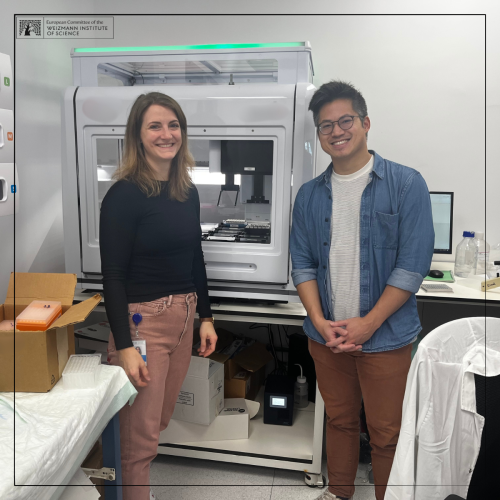
Meet Dr. Kiara Freitag and Dr. Truong-San Phan, Weizmann Institute postdoctoral researchers in the lab of Prof. Ido Amit. Originally from Germany, these two researchers are advancing research with far-reaching implications for human health in their individual work in Alzheimer’s and inflammatory diseases.
See below for an interview with these two inspiring Weizmann Institute researchers.
Interview with Dr. Kiara Freitag
What brought you to the Weizmann Institute of Science?
I came to work specifically with Ido Amit and to be at a place where cutting-edge technology is invented and used to solve real-world problems and develop therapeutic strategies for disease. I especially wanted to study the role of the immune system in neurological diseases such as Alzheimer’s disease.
What are you studying and researching in your postdoctoral program?
I am working on Alzheimer’s disease, one of the most common forms of dementia, affecting many people worldwide. To date, we still have only very limited therapeutic approaches, in part because we still do not fully understand the key drivers of the disease. The immune system has been shown to play an important role, but until recently we lacked tools to screen—at high throughput—potential therapeutic target molecules and regulators. In my postdoc, I developed a technology to engineer and genetically modify microglia, the immune cells of the brain, to identify how microglia need to be changed in order to be protective in Alzheimer’s disease.
What makes the Weizmann Institute of Science unique, in your experience?
The community and social events, the strong social structure on campus (clubs, sports, gardens, and many people living on campus), and the inspirational spirit and dedication of so many people.
What is something that you will take with you when you complete your postdoctoral program?
A unique lesson I learned here, one I would not have learned anywhere else given the surrounding circumstances, is the confidence and attitude that, no matter what happens, motivation and vision cannot be destroyed by the loss of anything material and will prevail.
What are your plans upon completion of your post doctorate?
My plan after my postdoc at Weizmann is to become an independent scientist and establish my own research group to continue studying neurodegenerative diseases.
Interview with Dr. Truong-San Phan
What brought you to the Weizmann Institute of Science?
I contacted Prof. Ido Amit close to the end of my PhD back in Germany after I received some recommendations. Of course, his laboratory at the Weizmann Institute is a topnotch address, and he is a well-known leader in the field of single-cell genomics technology. I specifically work in the field of inflammatory and autoimmune diseases that is still under-researched and I wanted to find novel approaches using new state-of-the-art technologies from Ido Amit’s laboratory to get a better understanding of these diseases and to advance new ways to for efficient long-lasting therapy.
What are you studying and researching in your postdoctoral program?
I am working on inflammatory diseases, such as psoriasis, one of the most prevalent chronic inflammatory skin disorders, in which the body’s immune system is harming the skin with overreactive immune responses. While current therapies help control the immune system’s response, the disease itself is not completely cured. Many patients experience relapses or don’t respond to treatment at all, rendering them to maintain medications for life. This suggests that there may be a hidden ‘memory’ in the skin that keeps the disease alive, even after the immune system’s harmful response has been stopped. The exact cause of this memory is still a mystery, but even small signals could be enough to maintain the disease. I am exploring in my study how the skin’s environment changes in a way that ‘remembers’ the inflammation, affecting both skin immune and non-immune cells. Using cutting-edge technologies, I look at how inflammation gets ‘stored’ in the skin and identify new potential treatment targets. Understanding how this tissue memory contributes to the disease, will eventually lead to better treatments and ultimately a cure for psoriasis.
What makes the Weizmann Institute of Science unique, in your experience?
Compared to other international research institutions, the Weizmann Institute of Science is very unique in its international program, integrating international researchers in all aspects of scientific, social and cultural engagement. The fact that internationals are taken care of with enormous, extraordinary efforts by the WIS not only makes living more comfortable but also improves their scientific research, productivity and creativity by allowing them to focus fully on discovery rather than logistics. This strong sense of community and support fosters genuine collaboration across disciplines and makes Weizmann an exceptionally attractive place to do ambitious and bold science.
Give an example of the multi-disciplinary nature of your work in the Weizmann Institute.
My work at Weizmann is highly multidisciplinary, combining clinical and basic immunology with cutting-edge single-cell genomics. I work with psoriasis patients from Hadassah Medical Center in Jerusalem, collecting paired skin biopsies, one during active, acute lesion inflammation and another after treatment and remission. Together with dermatologists and physician-scientists, we coordinate and conduct this translational study to uncover tissue memory signatures at the chromatin and RNA level in the WIS, helping to explain how psoriasis can persist and relapse after current therapies.
How do you implement AI in your research?
I use deep generative-based models like scVI-tools to analyze large single-cell transcriptome and chromatin data sets from mouse models and psoriasis patient samples. These tools help me identify subtle tissue memory signatures and understand how immune cells and skin cells change during inflammation, treatment, and remission and how they memorize and store inflammatory potential for future flare-ups and disease relapse.